

Inlays. Onlays. (Indirect Seals)

Inlays, onlays, and overlays are indirect fillings because they need to be made in a dental laboratory, not directly in the dentist’s office. They are tooth-colored fillings that require two visits to the office before they are fixed in the mouth.
Indirect fillings are made when a large part of the tooth is affected and there is not enough tooth structure. Clinically made fillings are not strong enough when the destruction of the tooth is greater due to fracture or decay. They are most often made on the 6th and 7th teeth, which are the chewing center and take all the pressure during the chewing act.
During the first visit, if the tooth is alive, anesthesia is applied and the tissues affected by caries are filed or the old filling is removed. An impression is taken and a color is selected. The impression is sent to the dental laboratory, where the inlay is made. Until the inlay is ready (within 5 working days), the doctor will make you a temporary filling.
At the second visit, the temporary filling is removed and the finished inlay is placed. If necessary, it is adjusted (filed), checked whether the boundaries of the inlay are accurate and whether the contacts with the antagonists (opposite teeth) are correct, and it is glued with photopolymer or glass ionomer cement.
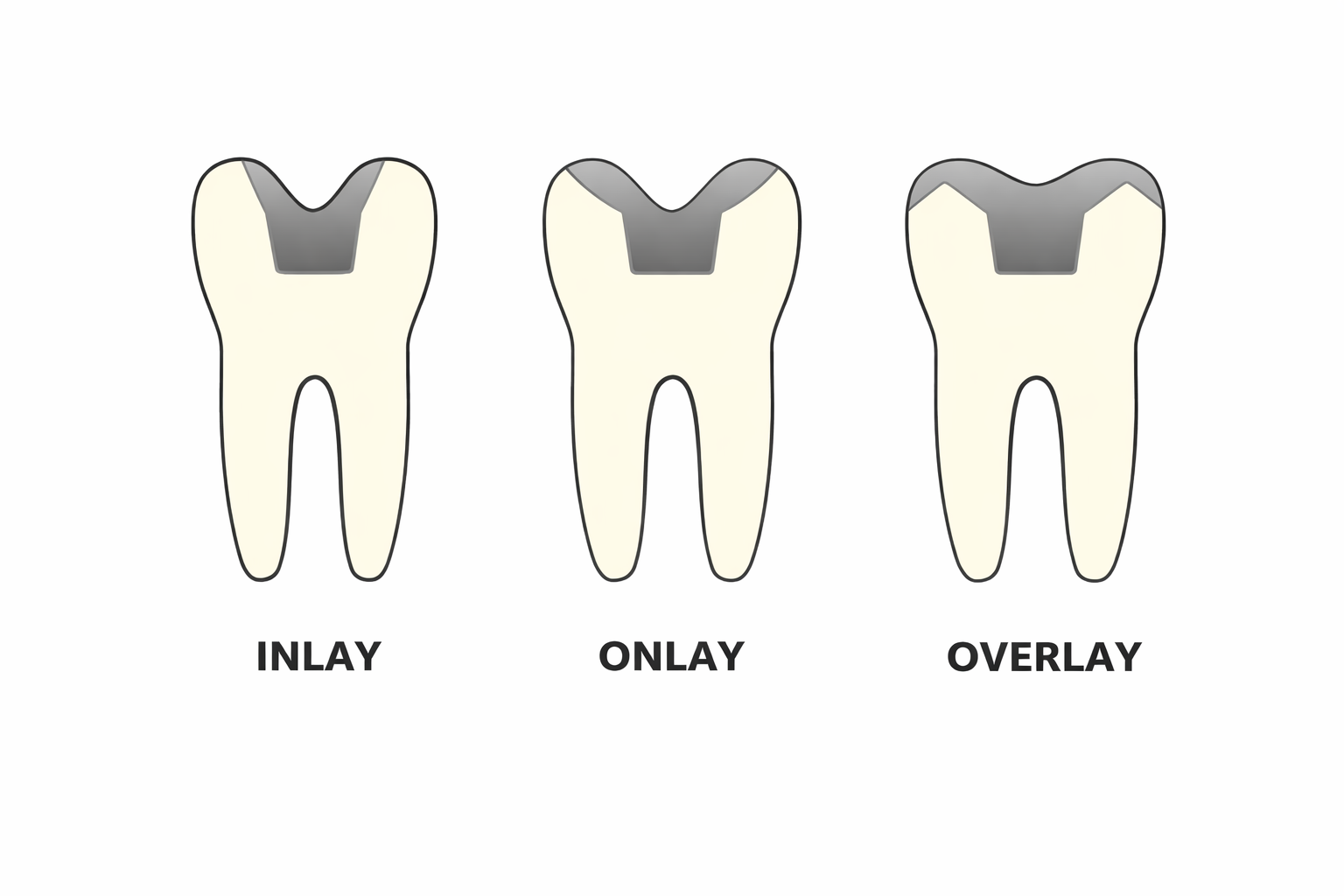
Inlays can be ceramic, photopolymer, zirconium and metal alloys (precious and non-precious) depending on the choice of material from which they are made. Metal alloy inlays are also strong and biologically tolerable, but a major drawback is aesthetics, which is why they are recommended for distal (back) teeth.

It covers a larger part of the tooth compared to an inlay. It is made to completely restore the shape of the affected tooth. The principle of making and placing is identical to that of an inlay.

Are the inlays healthy?
These fillings are much more durable, biologically tolerable and highly aesthetic, and their lifespan is longer (over 30 years) compared to regular fillings.
They are made extremely precisely and with the color of the teeth.
When is it impossible to place inlays?
- When enamel is missing and the tooth is very low (shallow cavities)
- Allergies to the material (most common for metal fillings)
To receive guidance information or competent consultation from our specialists, do not hesitate to contact us – 0877 17 80 18